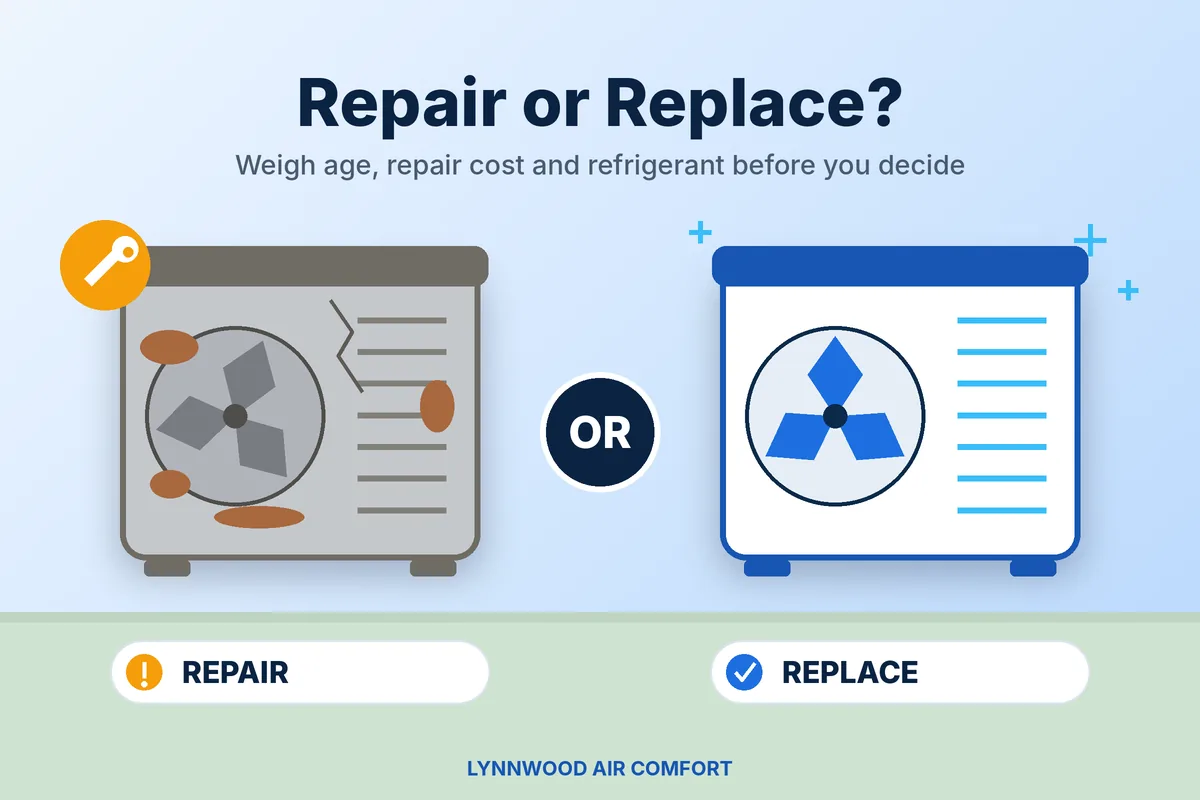
Repair your AC if it is fairly young, the problem is a single minor part, and the repair costs much less than a new system. Replace it if the system is old, the repair is major (a compressor or coil), or you have been paying for repairs every season. When the answer is unclear, a written replacement quote lets you compare real numbers instead of guessing.
Nobody wants to spend thousands on a new system, and nobody wants to put money into one that fails again next summer. Here are the factors that matter, in order.
How old is the system?
Age is the first thing to check. Central air conditioners are commonly cited as lasting roughly 15 to 20 years, though maintenance and sizing change that a lot. A repair on a 6-year-old system is usually a good investment. The same repair on a 17-year-old system often is not.
The serial number on the outdoor unit's data plate usually encodes the manufacture date, and a technician can read it in seconds.
What is actually broken?
Not all repairs are equal. Ask the technician to explain what failed, why it failed and whether other parts are close behind.
- Usually worth repairing: a capacitor, contactor, fan motor, thermostat or condensate clog. These are common, relatively affordable parts.
- Often points toward replacement: a failed compressor, a leaking evaporator or condenser coil, or a repeat refrigerant leak. These are the most expensive repairs, and they often show up when the whole system is wearing out.
How does the repair cost compare with replacement?
A widely used rule of thumb: if a repair costs more than about half the price of a replacement, or if the system is old and the repair is large, replacement usually makes more sense. It is a guide, not a law.
Get the repair quote in writing, and compare it with a written replacement quote. The AC replacement cost guide explains what drives those numbers.
What refrigerant does it use?
Older systems may use R-22 refrigerant, which is no longer produced. If an R-22 system develops a leak, recharging it can be very expensive, and that alone often tips the decision toward replacement. Newer systems use different refrigerants. The label on the outdoor unit usually lists it.
How often has it needed repairs?
One repair in several years is normal. Repairs every summer are a pattern. Keep a simple record of what you have spent, and add the new repair to the total.
If you also have two or more of the warning signs of a failing AC, such as rising bills, uneven cooling or odd noises, the system is likely near the end of its life.
What else should you consider?
- Comfort and efficiency. Newer systems use less electricity, and a new unit can fix uneven cooling if it is sized and installed properly. See what size AC you need.
- Heating too. If you are replacing anyway, a heat pump can handle both cooling and heating. See heat pump vs. central AC.
- Timing. Replacing in spring or fall, on your own schedule, beats an emergency decision in a heat wave. The replacement timeline guide shows what to expect.
Quick decision guideRepair when the system is under about 10 years old, the fix is a minor part, and the cost is small compared with a new system. Replace when the system is 15 years or older, the fix is major, or you keep paying for repairs. In between, get both quotes.
What should you do next?
- Find the system's age and refrigerant type from the data plate
- Get the repair quote in writing, with the failed part named
- Get a written replacement estimate with a load calculation
- Compare the two, along with how much longer you expect the system to last
The AC repair guide and the replacement and installation guide cover both paths in more detail.
Frequently asked questions
Is it worth repairing a 15-year-old AC?
Sometimes, if the repair is minor and inexpensive. If it is a major repair like a compressor or coil, replacement is usually the better value.
How do I know if the repair cost is too high?
A common rule of thumb is that a repair costing more than about half of a replacement is a warning sign. Compare written quotes for both.
Does an R-22 system need to be replaced?
Not automatically, but because R-22 is no longer produced, leak repairs can be costly and often push owners toward replacement.
About this articleGeneral guidance from Lynnwood Air Comfort, a free referral service. It is not a substitute for an on-site inspection by a qualified technician.